In yesterday’s journal entry, I said, “Any change in the weather is welcome.” I was wrong. But more on that later.
Today started out nice. A few puffy clouds. Strong current. Little wind. Surface of the river smooth as glass. Only one small barge all morning. I was mostly drifting with the current, occasionally putting paddle in water to keep me headed in the right direction. Conditions like that are hypnotic. Silent. Peaceful. Just watching the birds and the tree-lined shore drift slowly past. It’s why a lot of paddlers paddle, I think.
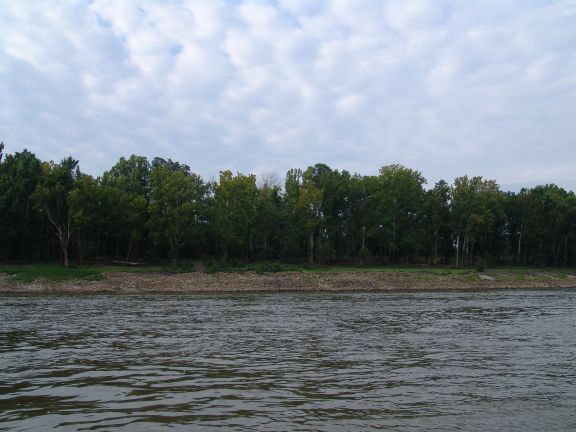

But the river has a way of reminding you not to get too complacent. In the sharp bends, especially.
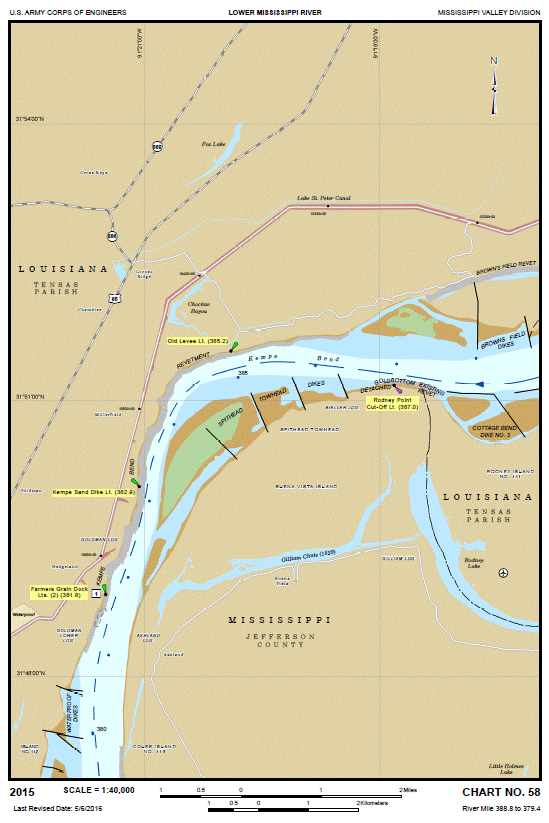
There’s this thing big river paddlers call “the boil line.” It’s the meandering line of turbulence, eddies, and whirlpools that form at the boundary between the fast current in the channel, and the slower waters near the shoreline. The boil line isn’t dangerous as it’s just tricky to paddle through. I usually like to stay just on the channel side of the boil line – it’s the fastest water not in the channel were the barges rule. In the sharp bends, the boil line often gets choppy and confused – a cauldron of eddies and whirlpools that form, disappear, and reform where and when least expected. And if a barge (or two) is has just recently gone through that bend, the waves are more than chop. Often their quite large, breaking, and from several different directions at the same time. Throw in some dikes and you’ve got a real mess of water to paddle through. And that’s what I had at Togo Bend. I’ve been through that sort of water before. And I’m never going to like it. This time, I negotiated the bend and water without incident, but it got me thinking.
Of all my adventures, this one is perhaps the more dangerous. I mean, hiking the AT was the longest. But it wasn’t particularly hard or dangerous. There are shelters always within hiking distance. And you’re very seldom far from another hiker. There’s a whole community of hiker support that stretches all the way from Georgia to Maine. In short, help is never far away if trouble happens. And my biking trip to Yellowstone may have been the hardest, but it too wasn’t particularly dangerous (aside from the usual hazards cyclist face from sharing a road with motorists.) Even in the remotest areas of Wyoming, I was always within bike riding distance of a town, a house, a ranch – somebody – where help could be found if I needed it. But canoeing the Lower Mississippi is far more dangerous than I originally gave credit. The river’s huge. And it’s lonely. River towns are days away. And if something breaks, you just can’t walk or ride for assistance. And should something happen on the water, like capsizing, well, it’s unforgiving. It’s literally swim or drown. I can’t recall ever being so frequently just one mishap away from death on the AT or on my bike as I am in my canoe on this river.

And late this afternoon, I’m not exaggerating when I say death was standing right beside me. Waiting for me to make a mistake.
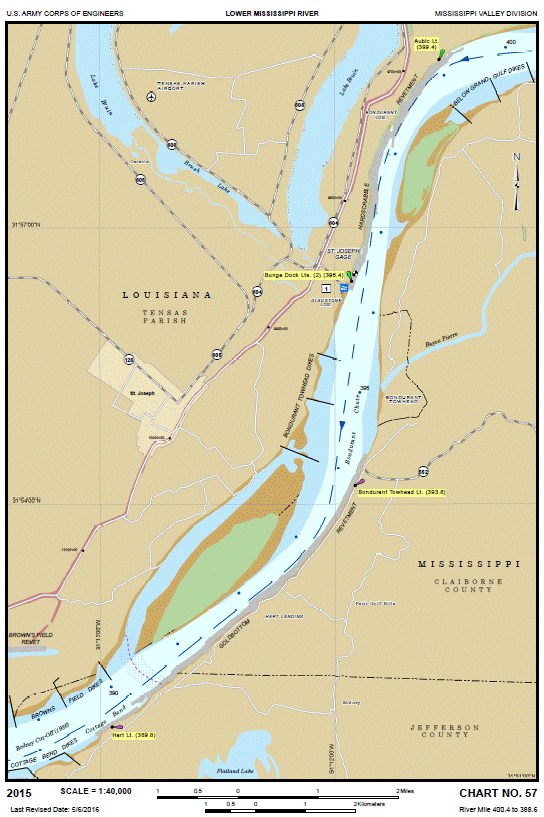
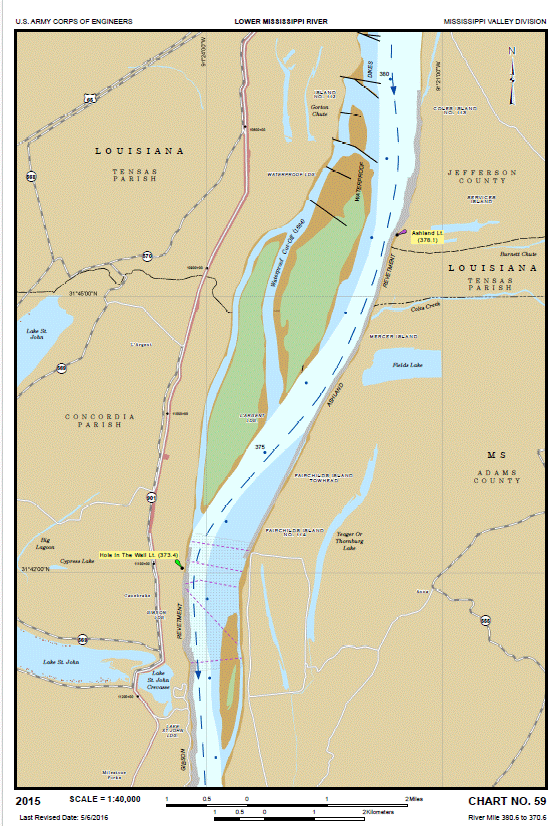
I had just reached my planned destination for the day, Upper Waterproof Island. Thunder was rolling in the not too distance, and I was anxious to find a reasonably sheltered campsite and get settled in before the rains hit. But as the thunderstorm’s roll cloud moved overhead, I knew I wasn’t going to make it. The only possible campsite in sight was on the island’s exposed sandbar, so I moved in close to shore. Exposed or not, it was my only option.

I was looking for a place to pull up onto the beach, when I looked up and saw a solid wall of water moving swiftly towards me. Then thunder. A crack of lightning. If I didn’t do something, I would be caught on a big water river in a little canoe in a severe thunderstorm.
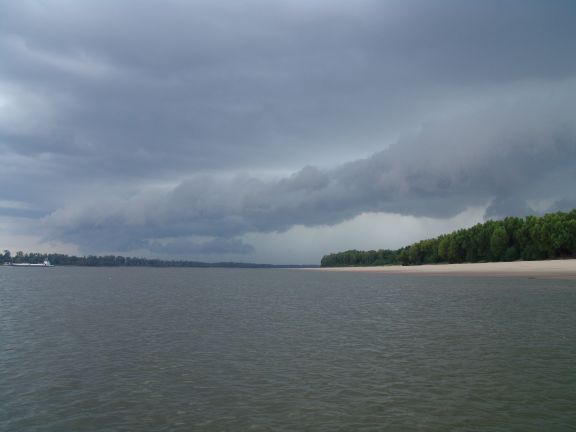
Fortunately, I was only a few dozen feet from the sandbar. So I paddled as hard as I could; I wanted run the canoe aground in the soft sand. Even though the water was less than a foot deep, I knew I didn’t have a chance of controlling the canoe – or my destiny – if I was afloat. Then the gust front hit. 50 mph winds. Then the rain. Rain so heavy I couldn’t see more than a dozen feet in front of me. And the canoe weathervaned around stern first, my back to the wind. It was grounded in maybe three inches of water on a small spit of sand extending from the island’s sandbar. I threw a towel over my head and across my back shoulders to try and protect me from the onslaught of wind and rain. And I knew if I tried to get out of the canoe, I’d lose her. My weight was the only thing keeping her grounded on that spit of sand.
So I sat there. And through the tunnel of vision afforded by that towel over my head, saw the waves. And the rain. And the blowing sand. And that the winds were blowing the water offshore. And in doing so, were helping to keep us aground and from blowing out to deeper waters where no man would have a chance of contending against the winds, rain, and waves of that thunderstorm. And for almost a half hour, while the storm unleashed its full fury against my back, I prayed for it to end. And that I would come out alive.
And then the winds shifted. And they were no longer at my back. But on the canoe’s beam. And that little spit of sand which had saved me from being blown onto the river, now threatened to capsize the canoe. We were being blown up against the sandbar. And with every wave crashing against the canoe, the higher and harder we were pushed up against the shallows. Water entered the canoe from every opening in the spray deck. With those winds and waves, it wouldn’t take much to overturn the little boat. Paddling was useless in those shallow waters. So I used my paddle as a pole. And struck it deep into the shallow sand, pushing and straining with all I had to turn the craft into the wind. And the waves. I was no longer fearful of dying. Now I fighting to save the canoe and my gear.
Finally, I managed to swing the canoe’s head into the wind. And for twenty minutes more I sat there. In the canoe’s rear cockpit. Waiting for the winds, waves, and rain to abate. So I could get out. And pull the canoe out of the water.
When the storm finally passed and the winds and rain moved on, I thanked God for staying with me through that ordeal. I then unloaded the canoe and assessed the damages. Fortunately, the canoe was in good shape; it only had four inches of water in it that I pumped out. There was no damage to the spray deck either. As for equipment, the only casualties appear to be my flip phone, camera, and handheld GPS unit. All were soaked (after taking a photo of the thunderstorm’s approaching roll cloud, I failed to close the zipper to the waterproof bag they were in.)
More thunderstorms are expected tonight. I’ve got my tent set up on the sandbar, the canoe pulled way up on shore and covered with a tarp, and all my gear either under the canoe’s tarp or in my tent’s vestibules. It’s the best I can do. I hope it’s good enough. I’m not going to lie, I’m a little shaken. That thunderstorm was a near thing. But I’m alive. And well.



 River and Bayou
Leave a reply to Will Thompson Cancel reply